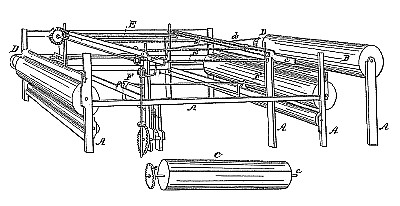
US Patent: 66
|
Forming Bats
Machinery for Forming Webs of Cloth of Wool, Hair, &c., Without or Weaving
|
|
Patentees:
|
| John Arnold (exact or similar names) - Norwalk, Fairfield County, CT |
| George G. Bishop (exact or similar names) - Norwalk, Fairfield County, CT |
| Manufacturer: |
| Not known to have been produced |
|
|
Patent Dates:
|
| Granted: |
Oct. 20, 1839 |
USPTO (New site tip)
Google Patents
Report data errors or omissions to steward
Joel Havens
|
|
Description: |
| Abstract:
The imperfections in the machine patented as aforesaid, and which it is the object of our improvement to remedy are 1st the doffer, and apron cylinders of the patented machine having equal motion as warp, and weft accumulate upon the apron and around the cylinders until a sufficient thickness is obtained the surface of each succeeding layer is more and more extended, and its motion proportionally increased so that the crossing weft will no longer cover the whole, and the work becomes un- even, to remedy this defect, and as an improvement on said machine we place upon the shafts of the doffer, and apron cylinder, matched cones governed by a movable belt in the same manner, and producing the same w ell known effect as matched cones in common use to regulate the varying, and relative motions of the cotton speeder by means of which the relative motions of the doffer and apron cylinders will vary according to the varying extent of surface around the carrier, and thus make even, and perfect work; 2d, wool, and hair being elastic and the different kinds of different elasticity it had been found very difficult if not impossible to work wool or other material possessing much elasticity on the patented machine on account of its springing under the fullers, in consequence of which the sheets of weft become folded, or contracted and will not retain an even width. To remedy this defect, and as an improvement on said machine we substitute combs in place of the fullers described in said machine, which we call faller combs. These combs are of the same form as the chain combs, described in said patent, and are connected with the same levers which support the faller rods by arms attached to each. The movement of the faller combs adopted in this improvement is also different from the movement of the faller rods in the patented machine in this. The rods rose gradually, and fell suddenly upon the weft. The faller combs are at rest until the moment in which the chain comb, and doffer are ready to deliver the weft when they rise by force of a cam or pin upon the same levers, and receiving the weft from the chain comb and doffer and carry it, down by an easy motion and deliver it on the warp, clearing themselves by a pin and spring in the same manner as the chain combs clear themselves as described in the said patented machine, being retarded in their downward movement by a spring or suspended weight to prevent their sudden descent. This spring may be a spiral spring hung from above or a cord from a spring pole governing the descent more or less gently as different materials may require.
Claim:
The application of matched cones governed by a movable belt to vary the relative motions or speed of the doffer, and apron cylinders as the varying extent of surface around the carrier is extended by the increasing thickness of the web. |
|