US Patent: 3,361,033
|
| Rotating and Swiveling Clamping Table for Machine Tools
|
|
Patentee:
|
|
| Johann Müller (exact or similar names) - Munich, Munich District, Bavaria, Germany |
|
|
Patent Dates:
|
| Applied: |
Aug. 17, 1965 |
| Granted: |
Jan. 02, 1968 |
|
Patent Pictures:
[
1 | 2
]
|
|
|
USPTO (New site tip)
Google Patents
Report data errors or omissions to steward
Joel Havens
"Vintage Machinery" entry for Friedrich Deckel GmbH
|
|
Description: |
| This invention is an improvement on the clamping table disclosed in co-pending application Ser. No. 258,482, filed Feb. 14, 1963, now Patent No. 3,248,101, by Johann Müller and Horst Lazenberger, for "Dual Swivel Axes Clamping Table," owned by a common assignee.
Claims priority, application in Germany, Aug. 28, 1964.
Abstract:
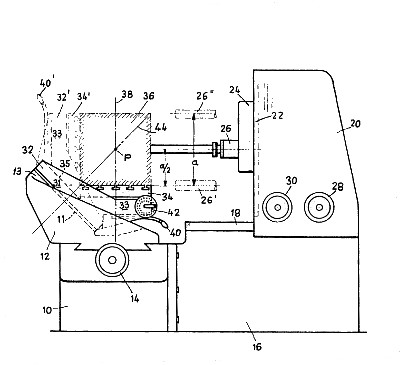
This invention relates broadly to machine tool clamping tables, and more particularly to a clamping table in which the clamping surface and the workpiece carried thereby can be brought from a vertical into a horizontal position, and vice versa, with slight effort, and in which the swivel and rotation axes of the clamping surface are positioned so as to enable the working range of operation of the machine tool used in conjunction therewith to be best utilized for machining all five surfaces of the workpiece on the clamping surface or plate. Clamping tables for machine tools are known in the prior art in which the clamping plate can rotate about an axis extending at right angles to the plane of the clamping plate to provide a turntable, and in which this axis itself can be swiveled about a swivel axis intersecting it an angle of approximately 45 degrees. With this arrangement a workpiece on the clamping plate can be brought into any position in space so that its entire surface can be machined with a machine tool spindle, with the exception of the side of the workpiece which bears on the clamping plate, without having to change the direction or attitude of the machine tool working spindle axis or without having to re-clamp the workpiece on the clamping plate. However, the known clamping tables of the prior art of this type have the disadvantage that the mass of the workpiece must be lifted a considerable amount or distance when the workpiece is brought from a vertical position into a horizontal position such as adjacent a machine tool spindle. The operator must then exert considerable lifting work at great effort to swivel the workpiece and table from one position to another. This problem is the subject of previously mentioned co-pending application Ser. No. 258,482, filed Feb. 14, 1963 by Johann Müller and Horst Lanzenberger, and it discloses a clamping table structure which indicates a solution to the problem of how to avoid the necessity of exerting lifting work when moving the workpiece and clamping plate from the vertical to the horizontal position. The clamping table of the present invention also provides a solution to this problem and enables the workpiece and clamping surface to be swiveled from one attitude to another with the exertion of little or no lifting work. This advantage of the clamping table of the present invention will not be discussed in detail in this specification since it was discussed in the previously-filed mentioned application.
Claim:
A machine tool clamping table comprising, a clamping plate for a workpiece, an intermediate portion, and a base portion, said clamping plate pivotally connected to said intermediate portion to rotate about a pivot axis normal to the plane of said clamping plate, said intermediate portion pivotally connected to said base portion along a swivel axis intersecting the pivot axis at substantially 45°, and said clamping plate having an upper surface facing the point of intersection of the pivot and swivel axes. |
|




)
)