US Patent: 3,416,407
|
| Loading Apparatus for Reciprocating and RotatingShaft
|
|
Patentees:
|
| Howard W. Renner (exact or similar names) - Worcester, Worcester County, MA |
| Herbert R. Uhtenwoldt (exact or similar names) - Worcester, Worcester County, MA |
| Manufacturer: |
| Not known to have been produced |
|
|
Patent Dates:
|
| Applied: |
Aug. 08, 1966 |
| Granted: |
Dec. 17, 1968 |
USPTO (New site tip)
Google Patents
Report data errors or omissions to steward
Joel Havens
|
|
Description: |
| Abstract:
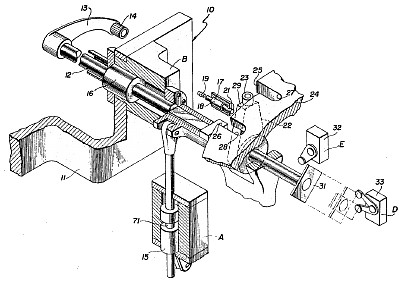
This invention has to do with a loading apparatus arranged to introduce workpieces into the operating area of a work machine tool and consisting of a shaft which is both slidably and rotatably carried in the machine tool housing, separate actuators are provided for rotating and sliding the shaft and means is provided to cause these actuators to operate in a cycle for the loading operation. The art of loading workpieces into a machine tool has received a considerable amount of attention in recent years. This is because, generally speaking, the time in which loading takes place is a time when the machine is not productive; it is important, therefore, from the point of view of economics, to reduce this time to a minimum. One such mechanism which is particularly useful for loading the outer races of ball bearings into an internal grinding machine is shown in the patent application of Uhtenwoldt, Ser. No. 533,904, filed Mar. 14, 1966; in this construction, a loading plug is automatically moved longitudinally and rotatably about a longitudinal axis from a low position in alignment with the machine chuck to an upper position in alignment with the workpiece chute pickup point. The loading apparatus is operated automatically by use of a sequential valve which shifts fluid from one operating cylinder to another of the mechanism. Although this apparatus operates effectively, it is expensive, because of the many hydraulic lines that are necessary. With such a complex electrohydraulic control, a certain "amount of time is involved because of the long hydraulic lines which add hydraulic response time to the system. These and other difficulties experienced with the prior art devices have been obviated in a novel manner by the present invention.
Claim:
A loading apparatus, comprising (a) a base, (b) a shaft slidably and rotatably carried in the base, (c) an arm extending laterally from one end of the shaft and having a workpiece-holding means located a substantial distance from the shaft, (d) a first actuator for rotating the shaft, (e) a second actuator for sliding the shaft, (f) means causing the actuators to move the shaft and the workpiece-holding means in a cycle to successive positions relative to the base, and (g) stop means assuring that the workpiece-holding means has reached one of the said positions before it starts to move to the next successive position in the cycle, the stop means being provided for assuring that the rotative movement of the shaft does not extend beyond a predetermined range and consisting of a cam follower extending from the shaft and a cam plate associated with the base and having guide surfaces to be contacted by the cam follower, the cam plate being a curved plate arranged concentrically of the shaft, the cam follower comprising a roller arranged with its axis perpendicular to the shaft axis, and the guide surfaces comprising edges of the plate such as would Abe generated by a radial line moved first axially only a short distance, secondly radially and axially to generate the inner end of a slot, thirdly axially only a second distance less than the first distance, fourthly radially only through a substantial angle, fifthly axially only a distance equal to the second distance, sixthly axially and radially to generate the inner end of a slot, and seventhly axially only a distance equal to the first distance.
|
|