US Patent: 84
|
| Reciprocating Steam Engine
|
|
Patentee:
|
|
| Edward D. Tippitt (exact or similar names) - Washington, DC |
| Manufacturer: |
| Not known to have been produced |
|
|
Patent Dates:
|
| Granted: |
Nov. 23, 1836 |
|
Patent Pictures:
[
1 | 2
]
|
|
|
USPTO (New site tip)
Google Patents
Report data errors or omissions to steward
Joel Havens
|
|
Description: |
| Abstract:
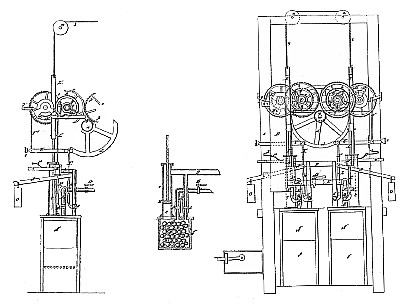
The nature of my invention consists in generating steam by injecting small quantities of water into hot generators (A,) filled with balls or plates of iron heated to a proper heat which is converted into steam instantaneously, and acts upon the piston, B3, (without a boiler) and which escapes immediately upon the ascent of the piston through an aperture into the escape tube g, where the steam may be condensed, or otherwise, leaving neither water or steam to cause an explosion. The generators may be made of cast, or wrought iron or copper, either cylindrical, or square, and in proper pro- portions, the content of which being about two cubical feet more, or less according to the power of the engine, or the quantity of water to be generated into steam. These generators are to be packed full of iron plates or balls not exactly in contact in all 80 points, to retain heat, at the same time so packed as to admit the water between them, and to form as munch surface as possible to generate the steam. It is also for another important purpose which will be here explained. If the generators are not packed with iron they must of course be filled with steam to a certain power upon the square inch according to the power of the engine required, in order to obtain that elasticity 40 necessary to drive the machinery, hence it will be seen that a great body of steam would have to be discharged at every stroke of the piston, butt by filling the generators with iron, there is no more steam produced than that which is necessary to fill the cylinder; and this is regulated by the quantity of water discharged into the generators; the steam from which upon the ascent of the piston immediately escapes through the upper escape into the escape tube (g) opened by the ascent of the piston.
Claim:
The above mode of generating steam by introducing a jet of water into generators, nearly filled with bars or balls of iron; as above described for the purpose of generating the quantity of steam required for each action of the piston, the vent-valve above described, the arrangement of machinery, for opening, and closing the water, and vent-valves as above described, and the arrangement of machinery for causing the pistons alternately to remain at rest, thereby allowing the generators to regain the requisite degree of heat as above described. |
|




)
)