US Patent: 16
|
Making Rubber Fabrics
Application of Caoutchouc to Clothes, Leather, and Other Articles
|
|
Patentee:
|
|
| Edwin M. Chaffee (exact or similar names) - Roxbury, Norfolk County, MA |
| Manufacturer: |
| Not known to have been produced |
|
|
Patent Dates:
|
| Granted: |
Aug. 31, 1836 |
|
Patent Pictures:
[
1 | 2 | 3 | 4
]
|
|
|
USPTO (New site tip)
Google Patents
Report data errors or omissions to steward
Joel Havens
|
|
Description: |
| Caoutchouc is the technical or archaic term for natural raw rubber, a highly elastic, tenacious, and waterproof plant substance.
Abstract:
I have invented, made, and applied to use a new and useful improvement in the preparing, coloring, and applying India-rubber to cloth of all kinds, leather, and other articles without the use of a solvent, which I call "Chaffee's Improvement in Rubber".
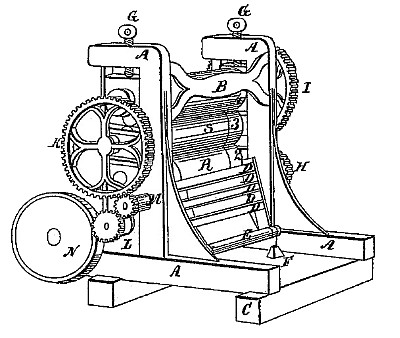
The India rubber undergoes an operation preparatory to its being applied to the cloth, and other articles, and the following is a description of that part of the machinery, and apparatus employed for the purpose. A hollow cylinder, or roller six feet long, and twenty seven inches in diameter heated by steam, or otherwise to about two hundred degrees of Fahrenheit, is surmounted by another cylinder of like length, and heated in like manner, and eighteen inches in diameter, the large, and small cylinders come in contact with each other on one side at about ten inches distant from the top of the larger one. The large cylinder revolves much faster than the small one, so that there is a compound rolling, and slipping action between the cylinders. Five bars are placed on the top of the large cylinder side by side each other leaving a space of about three fourths of an inch between them, the bars are one and a half inch thick, twelve inches wide, and about six feet long, the edges which lie in contact with the cylinder are convex or circular, and so constructed that when one corner of the edge touches it, the other recedes from it thus leaving a wedge like space for the rubber to enter beneath the bars. What I mean by the corner of the edge is the angles formed by the two sides of the bars, and their circular edges, the one being; an acute, and the other an obtuse angle, which are more or less acute or obtuse according to their situation on the cylinder, the said bars being substitutes for so many cylinders, but are better adapted to sifting the coloring between them, the), are held in contact with the cylinder, or nearly so by weights or screws arranged for the purpose. If the rubber is to be colored, the coloring matter in fine powder should be sifted, or otherwise put into the spaces between the bars where it will be incorporated with the rubber as it passes between the bars and the cylinders.
Claim:
The preparation, and application of India rubber to all kinds of cloths, leathers, and other like substances without the use of a solvent in the manner aforesaid. |
|




)
)
)
)