US Patent: 314,353
|
| Steam Engine Governor
|
|
Patentee:
|
|
| Joseph W. Thompson (exact or similar names) - Salem, Columbiana County, OH |
|
|
Patent Dates:
|
| Applied: |
Nov. 29, 1884 |
| Granted: |
Mar. 24, 1885 |
|
Patent Pictures:
[
1 | 2
]
|
|
|
USPTO (New site tip)
Google Patents
Report data errors or omissions to steward
Joel Havens
"Vintage Machinery" entry for Buckeye Engine Co.
|
|
Description: |
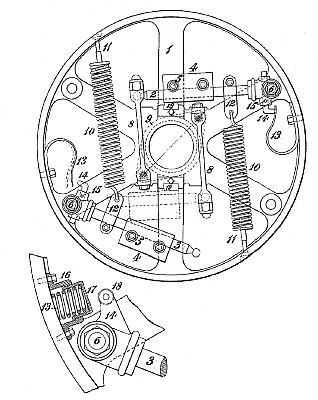
| My invention relates to centrifugal governors or regulators of the class set forth in the following Letters Patent of the United States, upon which it is an improvement, to wit: Reissued Letters Patent No. RE8,433, dated September 24, 1878, to myself and the Buckeye Engine Company as my assignee, and Letters Patent No. 204,924, dated June 18, 1878, to myself and Nathan Hunt and said Buckeye Engine Company as our assignee.
Abstract:
The object of my present invention is to promote the attainment of perfect isochronal regulation by counteracting the variable accretion of centripetal force induced in the operation of a governor of the type above specified by the action of the resistance of the parts actuated by the movable eccentric under different degrees of leverage in different positions of the weight-arms. To this end my invention, generally stated, consists in the combination, with a movable valve-operating device and weighted arms and springs adapted to vary the position thereof in opposite directions by the action of centrifugal and centripetal force, respectively, of auxiliary centrifugally acting springs adapted to supplement the action of the weights during the moiety of the traverse of their arms adjacent to the inward limit of their range of motion.
Claim:
In a centrifugal governor of the type specified, the combination, substantially as set forth, of a movable valve-operating device, a weighted arm and centripetally acting spring adapted to vary the position of such device in opposite directions by the action of centrifugal and centripetal force, respectively, and an auxiliary spring adapted to supplement the centrifugal action of the weight during the moiety of the traverse of its arm adjacent to the inward limit of its range of motion. |
|




)
)